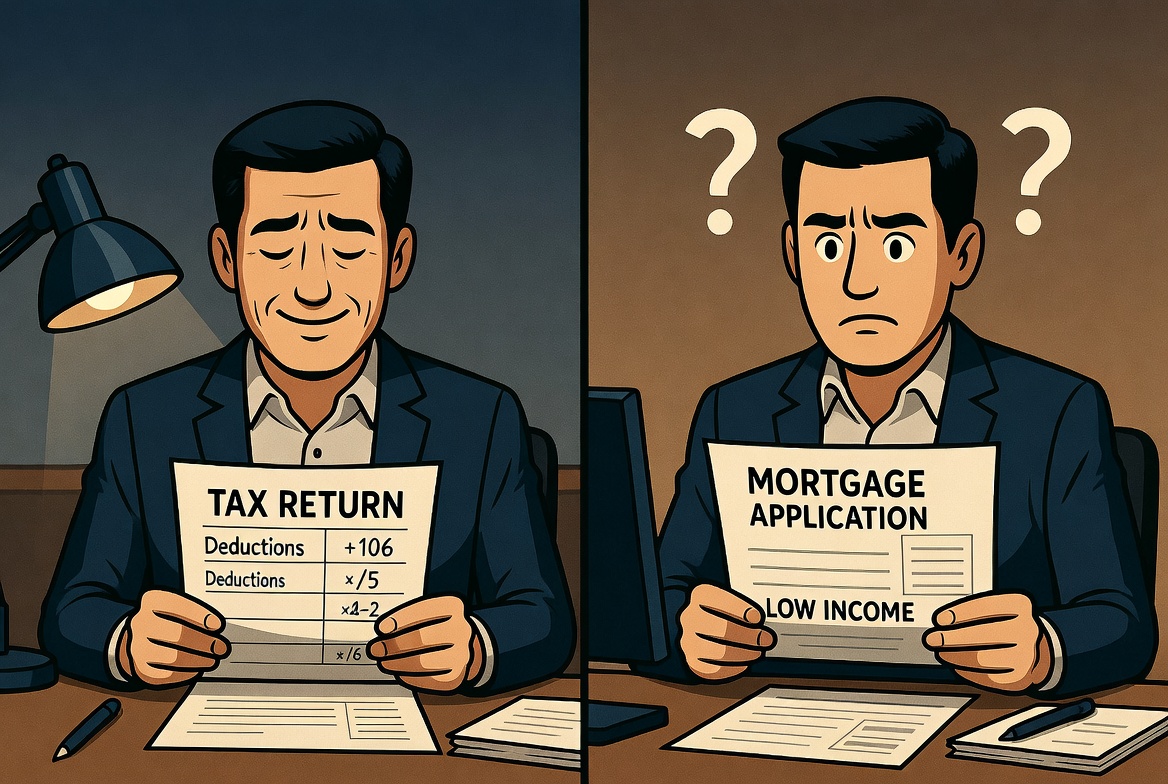
Every write-off you claim to lower your tax bill also lowers the income a lender sees when you apply for a mortgage. The same strategy that saves you money every April can shrink your borrowing power every other month of the year — and most self-employed borrowers don't realize it until they're already in the process.
Why does this happen?
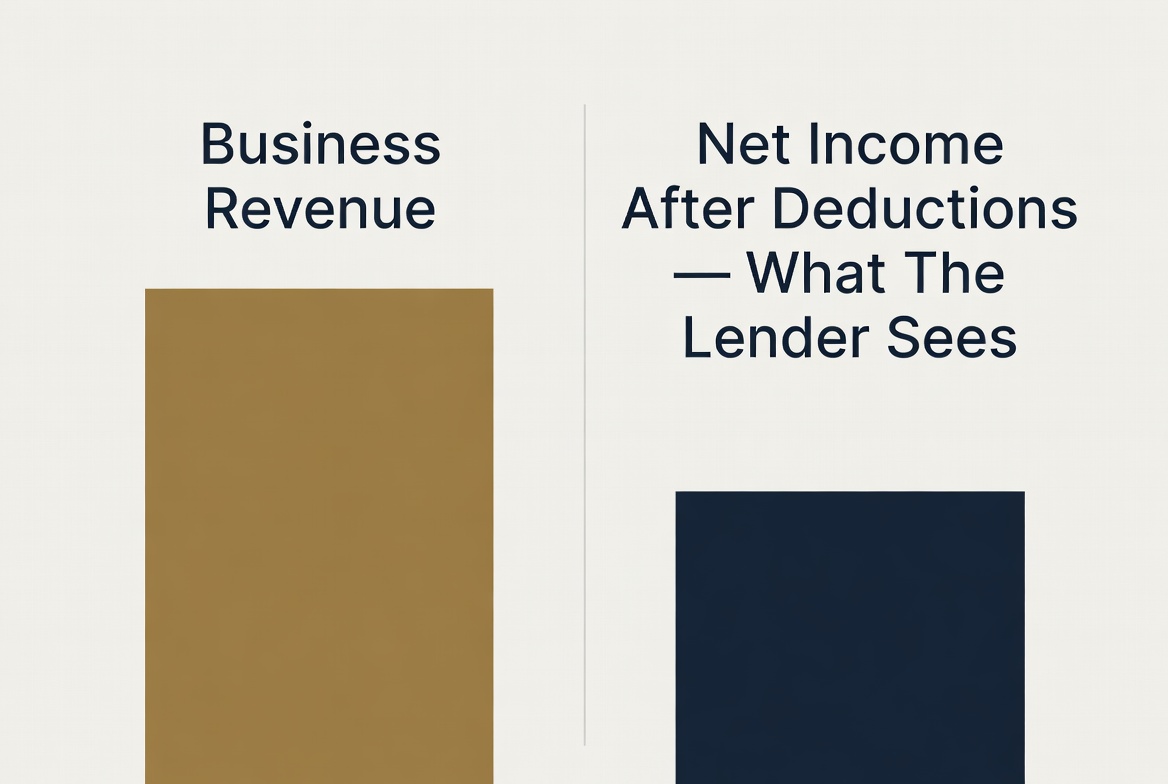
Lenders don't look at your revenue. They look at your net income — the number left after your accountant has done their job and deducted everything they can. If your business brings in $120,000 but you write off $50,000 in legitimate expenses, a lender sees $70,000, not $120,000. That's the number your mortgage gets sized against.
This is completely rational from a lender's perspective — they're lending against the income you've told the CRA you actually earned. But it means the tax strategy that's smart every April can work directly against you every other month of the year.
The lower your reported income, the lower your tax bill — and the lower your mortgage approval. You can't fully optimize for both at once.
What lenders actually look at
Most lenders want two years of Notice of Assessment (NOA) and full tax returns (T1 Generals), then average your net income across those two years. If your income has grown quickly and you write off aggressively, that average can look surprisingly low relative to what you actually take home month to month.
What can you actually do about it?
- Plan two years ahead of applying, not two months. If a mortgage is on the horizon, talk to your accountant about the trade-off between minimizing tax now and maximizing qualifying income later.
- Look at stated-income or alternative lending programs. Some lenders offer programs designed specifically for self-employed borrowers that weigh bank deposits or business financials differently than a standard T1-based calculation.
- Consider a private lending solution. Private lenders often care more about equity and overall financial picture than a rigid two-year average, which can matter if your write-offs are legitimate but your qualifying number doesn't reflect reality.
Bottom line
There's no single right answer here — it's a genuine trade-off between paying less tax and qualifying for more mortgage. The mistake is not knowing the trade-off exists until you're already mid-application. Have the conversation with your accountant and your broker before you need the mortgage, not after.
Patrick Sawler
Principal Broker, Craigburn Capital
I look forward to hearing from you in regard to your mortgage needs.
902-465-5533. I answer.
Patrick
p.s— You can click on this link to start the process whenever you are ready. Schedule your meeting with me here.
p.s.s— I should tell you that I am licensed in Nova Scotia Brokerage (2025-3000179) Broker (2025-3000180), Ontario (M23006699).
p.s.s.s— You can download my new mortgage app here
Patrick Sawler is a mortgage broker and owner of Craigburn Capital, licensed in Nova Scotia and Ontario, with private financing available in New Brunswick and PEI. He answers his phone.
Ready to have a real conversation? Call 902-465-5533 or start your application here.