I want to be upfront about why I'm writing this: I'm a mortgage broker, not a landlord or a rental investment advisor. My job is helping people finance real estate, not talking anyone into or out of renting. So this isn't a "renting is bad" post. It's a look at something I think matters more for the people I actually work with — what happens if you wait.
"I'll buy once I've saved a bigger down payment" is one of the most common things I hear from first-time buyers, and it's not an unreasonable instinct. But it treats the price of the home you're saving toward as if it's standing still. It isn't. Here's what actually happened over the last decade.
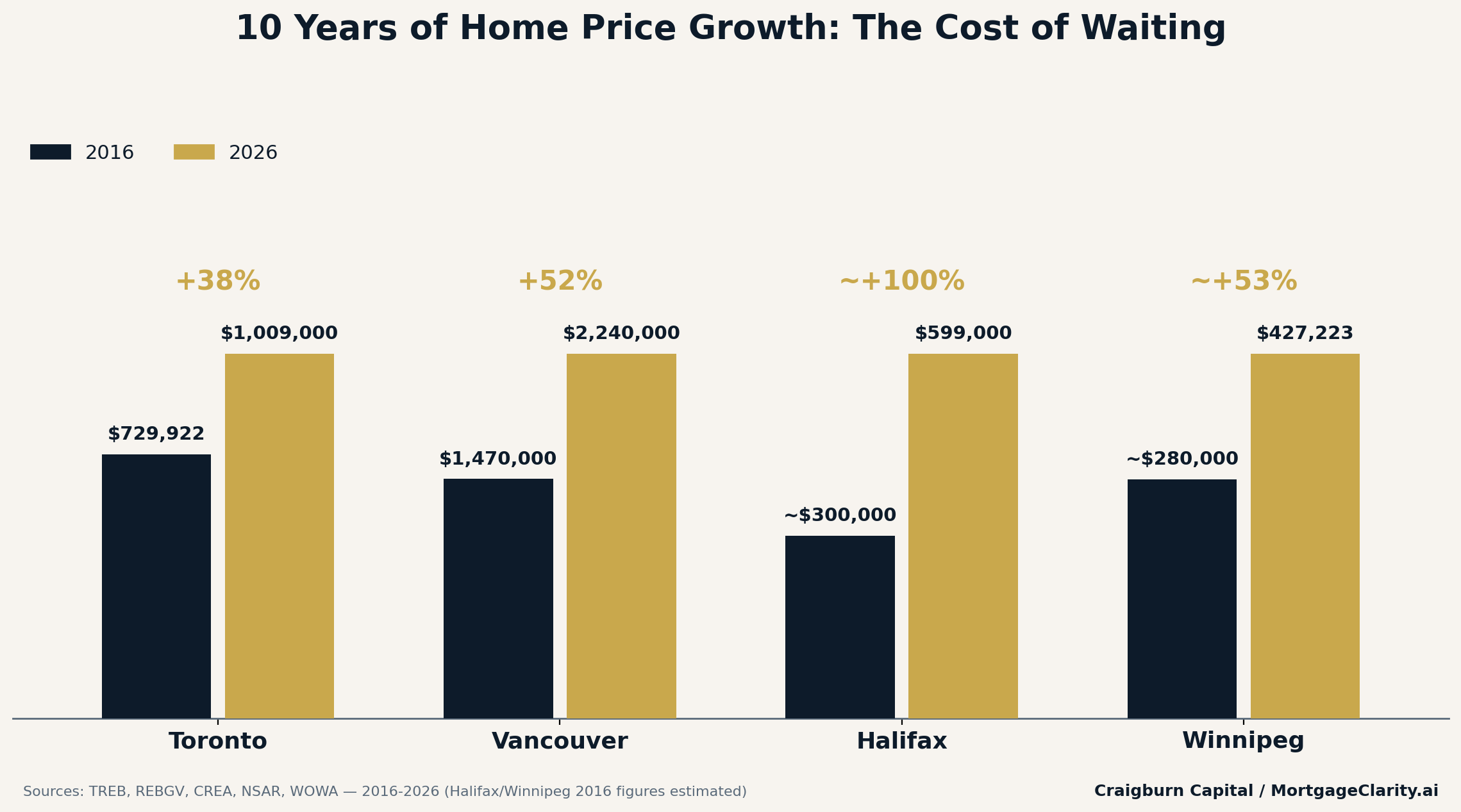
How much have home prices actually grown over the past 10 years?
| City | 2016 Avg. Price | 2026 Avg. Price | 10-Year Growth | Annualized |
|---|---|---|---|---|
| Toronto | $729,922 | $1,009,000 | +38% | ~3.3%/yr |
| Vancouver (detached benchmark) | $1,470,000 | $2,240,000 | +52% | ~4.3%/yr |
| Halifax (estimated) | ~$300,000 | $599,000 | ~+100% | ~7.2%/yr |
| Winnipeg (estimated) | ~$280,000 | $427,223 | ~+53% | ~4.3%/yr |
Sources: TREB/TRREB (Toronto average selling price), REBGV (Vancouver detached benchmark price), CREA/NSAR and WOWA (Halifax), CREA/WRREB (Winnipeg). Halifax and Winnipeg 2016 figures are estimated from available historical reporting, as clean decade-old data is harder to source for these boards than for Toronto and Vancouver. Past appreciation does not guarantee future performance — markets can and do decline, as Toronto and Vancouver both have in parts of the past two years.
Halifax is the one that should really get your attention if you're local. A market that used to be known as one of the most affordable in the country has, by most reasonable estimates, roughly doubled in the past decade. That's not a Toronto or Vancouver story — that's ours.
What does that actually mean for someone trying to save up a down payment?
Let's make this concrete with Halifax, since that's where most of the people reading this actually live. Say two people, both with $40,000 saved, started at the same point 10 years ago.
Person A buys in 2016
Average Halifax home price: roughly $300,000. A $40,000 down payment gets them into the market at just over 13% down. Over the next 10 years, their home appreciates alongside the broader market — if it merely tracked the average, that $300,000 home is worth somewhere in the neighbourhood of $600,000 today. Meanwhile, every mortgage payment for 10 years has been paying down real principal on an asset they own.
Person B waits and saves
Person B decides to keep saving for a bigger down payment before buying — a completely reasonable, responsible-sounding plan. Let's be generous and say they manage to save an additional $25,000 over that decade, on top of their original $40,000, bringing them to $65,000. But the average home in Halifax hasn't stayed at $300,000 — it's roughly doubled to around $599,000. Their $65,000 now represents about 11% down, a smaller share of the purchase price than Person A started with a decade earlier, despite years of disciplined saving.
Does this mean everyone should buy immediately, no matter what?
No — and I'd be doing you a disservice if I implied that. There are good reasons to wait: you might not have stable income yet, you might be planning a move, you might need real time to fix your credit, or you might simply not have enough for a responsible down payment and closing costs right now. Waiting because you genuinely aren't ready is different from waiting because you're chasing a "someday I'll have saved enough" number that the market keeps moving on you.
And I'll say plainly: nobody, including me, can guarantee the next 10 years will look like the last 10. Rates move, markets correct, and Toronto and Vancouver have both seen real price declines over parts of the past two years. This isn't a promise that home prices always go up forever. It's a look at what actually happened, and a reason to at least run your own numbers rather than assume waiting is automatically the safer choice.
So what should you actually do with this?
If you're sitting on a down payment that feels "not quite big enough" and wondering whether to keep waiting, the useful question isn't "how much more should I save?" It's "what am I actually qualified for right now, and what would waiting realistically cost me if prices in my market keep moving the way they have?" That's a conversation, not a guess — and it's the one I have with people every week.
If you want to actually run these numbers against your own situation — your city, your savings, your timeline — that's exactly what I'm here for. No pressure, just the real math.
— Pat